Jim Shaw Jim Shaw
0 Course Enrolled • 0 Course CompletedBiography
L6M2 test-preparation routine proven to help you pass the exams
Please select our FreeCram to achieve good results in order to pass CIPS certification L6M2 exam, and you will not regret doing so. It is worth spending a little money to get so much results. Our FreeCram can not only give you a good exam preparation, allowing you to pass CIPS Certification L6M2 Exam, but also provide you with one-year free update service.
CIPS L6M2 Exam Syllabus Topics:
| Topic | Details |
|---|---|
| Topic 1 |
|
| Topic 2 |
|
| Topic 3 |
|
| Topic 4 |
|
Books CIPS L6M2 PDF - Trustworthy L6M2 Source
The Global Commercial Strategy (L6M2) practice test questions are customizable which means that the customers can customize the time and L6M2 exam questions types according to their needs. These CIPS L6M2 Practice Tests are based on real based examination scenarios which help the students practice under real L6M2 exam questions pressure and learn to control it.
CIPS Global Commercial Strategy Sample Questions (Q30-Q35):
NEW QUESTION # 30
SIMULATION
Compare and contrast an aggressive and conservative approach to business funding.
Answer:
Explanation:
Comparison of Aggressive vs. Conservative Business Funding Approaches
Introduction
Businesses adopt different funding strategies based on their risk tolerance, growth objectives, and financial stability. Two contrasting approaches to business funding are:
Aggressive Funding Approach - Focuses on high-risk, high-reward strategies with more debt and short-term financing to fuel rapid expansion.
Conservative Funding Approach - Emphasizes financial stability, risk aversion, and long-term security, often relying on equity and retained earnings to fund operations.
Each approach has advantages and risks, influencing a company's liquidity, cost of capital, and financial sustainability.
1. Aggressive Business Funding Approach (High Risk, High Reward)
Definition
An aggressive funding strategy involves maximizing short-term debt, high leverage, and minimal cash reserves to accelerate growth and expansion.
✅ Key Characteristics:
Relies heavily on debt financing (bank loans, corporate bonds, short-term credit).
Prioritizes rapid growth and high returns over financial security.
Uses minimal equity financing to avoid ownership dilution.
Maintains low cash reserves, assuming cash flows will cover liabilities.
Example:
Startups and tech firms (e.g., Tesla, Uber, Amazon in early years) often borrow aggressively to scale rapidly.
Private equity firms fund acquisitions using high leverage to maximize returns.
Advantages of Aggressive Funding
✔ Faster business expansion - Capital is readily available for investments.
✔ Higher return potential - More funds are allocated to revenue-generating activities.
✔ Lower equity dilution - Existing shareholders maintain control as funding is primarily debt-based.
Disadvantages of Aggressive Funding
❌ High financial risk - Heavy debt increases vulnerability to economic downturns.
❌ Liquidity problems - Low cash reserves can cause issues during slow revenue periods.
❌ Higher borrowing costs - Lenders charge higher interest due to the risk involved.
Best for: Fast-growing companies, high-risk industries, and businesses with predictable cash flows.
2. Conservative Business Funding Approach (Low Risk, Long-Term Stability) Definition A conservative funding strategy focuses on low debt levels, high liquidity, and long-term financing to ensure financial stability and steady growth.
✅ Key Characteristics:
Uses retained earnings and equity financing over debt.
Minimizes reliance on short-term credit to avoid financial pressure.
Maintains high cash reserves for financial security.
Focuses on steady, sustainable growth rather than rapid expansion.
Example:
Berkshire Hathaway (Warren Buffett's company) follows a conservative funding model, relying on retained earnings rather than excessive debt.
Family-owned businesses often prioritize financial stability over rapid expansion.
Advantages of Conservative Funding
✔ Lower financial risk - Reduces dependence on external creditors.
✔ Stable cash flow - Ensures business continuity during economic downturns.
✔ Better credit rating - Stronger financial health allows for lower borrowing costs if needed.
Disadvantages of Conservative Funding
❌ Slower business growth - Limited access to capital can restrict expansion.
❌ Missed market opportunities - Competitors with aggressive funding may outpace the company.
❌ Higher cost of capital - Equity financing (selling shares) dilutes ownership and reduces profit per share.
Best for: Established businesses, risk-averse industries, and companies focusing on long-term sustainability.
3. Comparison Table: Aggressive vs. Conservative Funding Approaches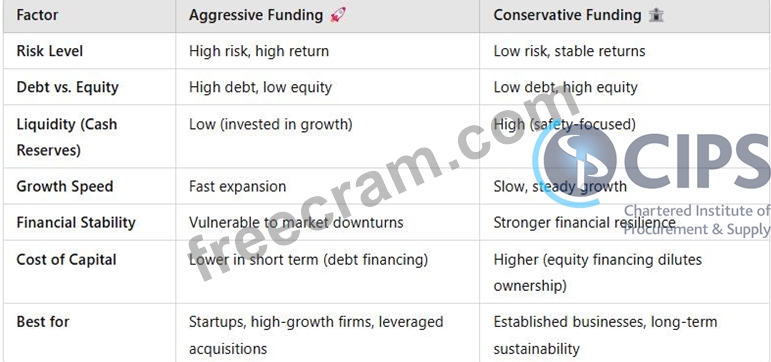
Key Takeaway: The best funding approach depends on industry, company stage, and risk appetite.
4. Which Approach Should a Business Use?
✅ Aggressive Approach is Ideal For:
Startups & High-Growth Companies - Need fast capital to capture market share.
Businesses in Competitive Markets - Companies that must outpace rivals through aggressive expansion.
Private Equity & Leveraged Buyouts - Maximizing returns through high debt strategies.
✅ Conservative Approach is Ideal For:
Mature & Stable Businesses - Companies prioritizing steady revenue and financial security.
Family-Owned Enterprises - Owners prefer low debt and long-term growth.
Risk-Averse Industries - Businesses in essential goods/services sectors where stability is more important than rapid expansion.
Hybrid Approach: The Best of Both Worlds?
Many businesses use a combination of both approaches, leveraging debt for growth while maintaining financial stability through retained earnings and equity.
Example:
Apple used a conservative strategy in its early years but adopted aggressive funding for global expansion post-2010.
5. Conclusion
The choice between aggressive and conservative funding depends on a company's growth goals, financial risk tolerance, and industry conditions.
✅ Aggressive funding maximizes short-term growth but increases financial risk.
✅ Conservative funding ensures stability but limits expansion speed.
✅ Most companies use a hybrid model to balance growth and financial security.
Understanding these approaches helps businesses optimize capital structure, manage risk, and align financing with strategic objectives.
NEW QUESTION # 31
SIMULATION
Evaluate diversification as a growth strategy. What are the main drivers and risks?
Answer:
Explanation:
Evaluation of Diversification as a Growth Strategy
Introduction
Diversification is a growth strategy where a company expands into new markets or develops new products that are different from its existing offerings. It is the riskiest strategy in Ansoff's Growth Matrix, but it can provide significant opportunities for business expansion, revenue diversification, and risk mitigation.
Diversification is driven by factors such as market saturation, competitive pressure, and technological advancements but also carries risks related to high investment costs and operational complexity.
1. Types of Diversification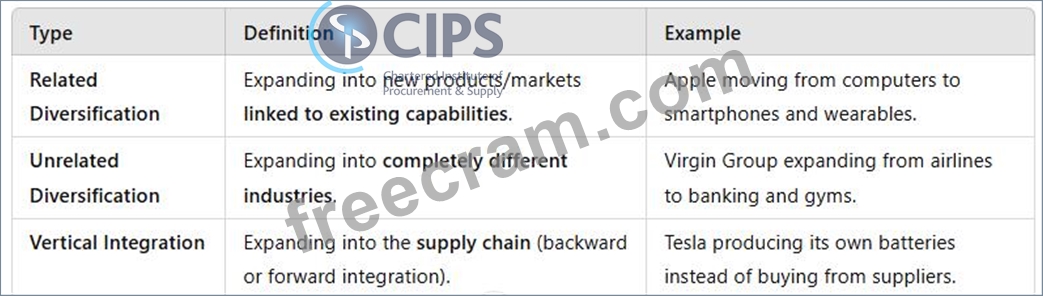
2. Main Drivers of Diversification
1. Market Saturation and Competitive Pressure
When a business reaches peak growth in its existing market, diversification helps find new revenue streams.
Competition forces businesses to explore new industries for continued growth.
Example: Amazon expanded from an online bookstore to cloud computing (AWS) due to competition and limited retail growth.
2. Risk Reduction and Business Sustainability
Diversifying reduces dependence on a single market or product.
Protects the business against economic downturns and industry-specific risks.
Example: Samsung operates in electronics, shipbuilding, and insurance, reducing reliance on one sector.
3. Leveraging Core Competencies and Brand Strength
Companies use existing expertise, technology, or brand reputation to enter new markets.
Example: Nike expanded from sportswear to fitness apps and wearable technology.
4. Technological Advancements & Market Opportunities
Digital transformation and innovation create opportunities for diversification.
Companies invest in new technologies, AI, and automation to expand their offerings.
Example: Google diversified into AI, smart home devices, and autonomous vehicles (Waymo).
3. Risks of Diversification
1. High Investment Costs & Uncertain Returns
Diversification requires significant R&D, marketing, and infrastructure investment.
ROI is uncertain, and failure can result in financial losses.
Example: Coca-Cola's failed diversification into the wine industry resulted in losses due to brand mismatch.
2. Lack of Expertise & Operational Challenges
Expanding into unfamiliar industries increases operational complexity and risks.
Companies may lack the expertise required for success.
Example: Tesco's expansion into the US market (Fresh & Easy) failed due to a lack of understanding of American consumer behavior.
3. Dilution of Brand Identity
Expanding into unrelated sectors can confuse customers and weaken brand strength.
Example: Harley-Davidson's attempt to enter the perfume market damaged its brand credibility.
4. Regulatory and Legal Barriers
Compliance with different industry regulations can be complex and costly.
Example: Facebook faced regulatory scrutiny when diversifying into financial services with Libra cryptocurrency.
4. Conclusion
Diversification can be a high-reward growth strategy, but it requires careful planning, market research, and strategic alignment.
✅ Main drivers include market saturation, risk reduction, leveraging expertise, and technology opportunities.
❌ Key risks include high costs, operational challenges, brand dilution, and regulatory barriers.
Companies must evaluate diversification carefully and ensure strategic fit, financial feasibility, and market demand before expanding into new industries.
NEW QUESTION # 32
SIMULATION
Discuss the role and influence of industry regulators and international bodies in the business environment.
Answer:
Explanation:
The Role and Influence of Industry Regulators and International Bodies in the Business Environment Introduction Industry regulators and international bodies play a critical role in shaping the business environment by enforcing regulations, setting industry standards, and ensuring fair competition. These organizations influence how businesses operate, impacting areas such as trade, finance, environmental sustainability, labor practices, and consumer protection.
Companies must comply with regulations set by both domestic industry regulators and global institutions to maintain legal and ethical business operations.
1. Role of Industry Regulators
Industry regulators are government-appointed or independent organizations that oversee specific sectors to ensure compliance with laws and standards. Their key functions include:
✅ Enforcing Compliance - Ensuring companies adhere to legal requirements (e.g., financial reporting, safety regulations).
✅ Promoting Fair Competition - Preventing monopolies and anti-competitive practices.
✅ Consumer Protection - Safeguarding consumer rights and ensuring product/service quality.
✅ Regulating Market Entry and Operations - Setting standards for licensing, pricing, and ethical conduct.
Example of Industry Regulators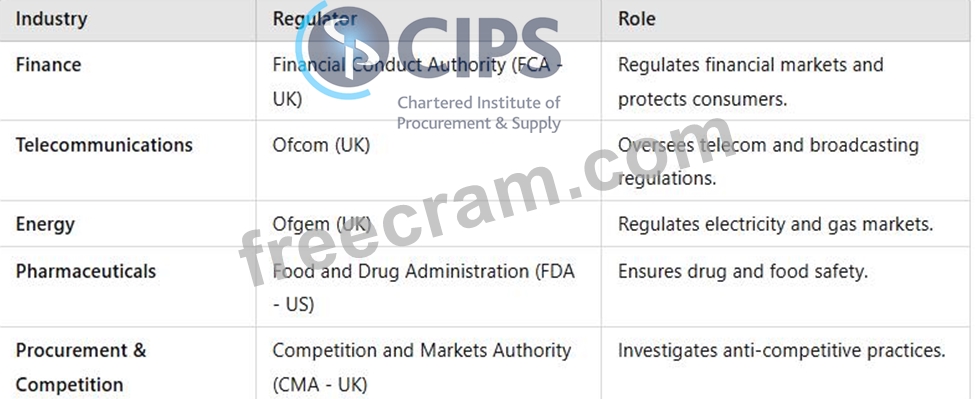
Case Example: The UK's Competition and Markets Authority (CMA) blocked Microsoft's acquisition of Activision Blizzard due to concerns over market dominance in cloud gaming.
2. Role of International Bodies
International bodies set global regulations, trade policies, and ethical standards that influence businesses operating across borders.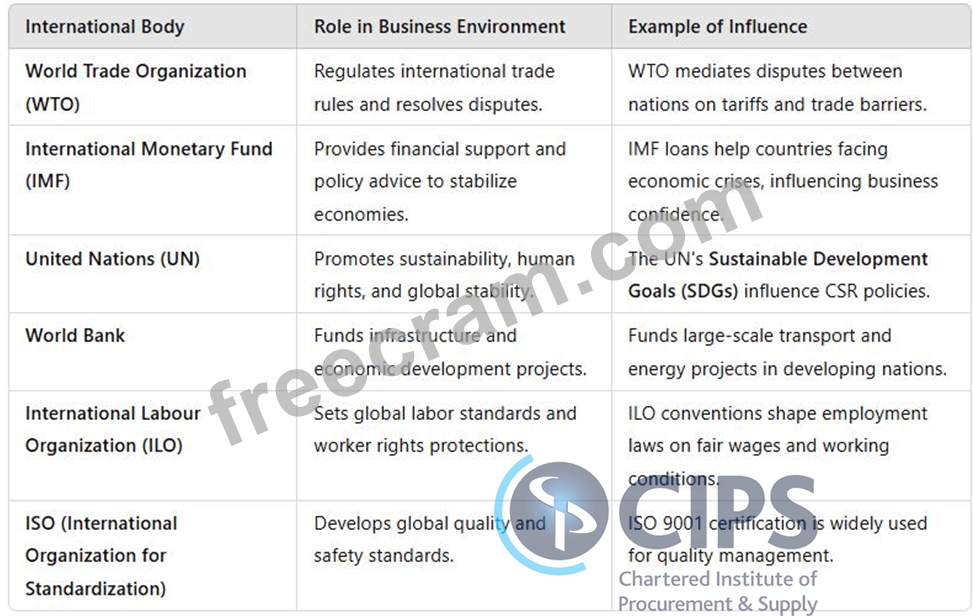
Case Example: The WTO's intervention in Brexit trade negotiations affected tariffs and supply chain costs for UK-based companies.
3. Influence of Industry Regulators and International Bodies on Business Strategy Businesses must align their strategies with regulatory and international frameworks to ensure compliance and avoid financial or reputational risks.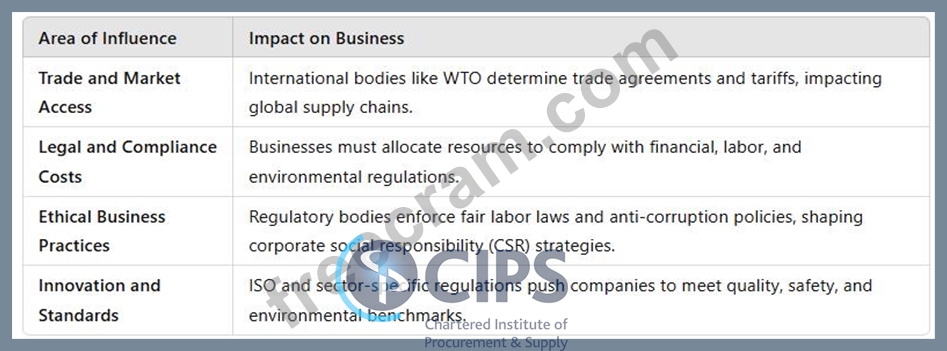
Example: The EU's General Data Protection Regulation (GDPR) forced global companies to enhance data protection policies or face heavy fines.
4. Advantages and Disadvantages of Regulatory and International Influence
✅ Advantages
Promotes Stability & Fair Competition - Reduces market manipulation and corruption.
Protects Consumers & Employees - Ensures safety, fair wages, and ethical standards.
Encourages Innovation & Sustainability - Businesses invest in R&D to meet regulatory requirements.
Facilitates Global Trade - International trade agreements create business opportunities.
❌ Disadvantages
Regulatory Burdens & Compliance Costs - Strict laws increase operational costs.
Trade Barriers & Bureaucracy - Lengthy regulatory approval processes slow down market entry.
Risk of Overregulation - Too many rules can stifle competition and innovation.
Example: The EU Emissions Trading System (EU ETS) requires manufacturers to pay for carbon emissions, increasing operational costs.
Conclusion
Industry regulators and international bodies shape the business environment by enforcing laws, ensuring ethical practices, and facilitating global trade. Companies must proactively monitor regulatory changes, integrate compliance into strategic planning, and adapt to international standards to maintain market competitiveness and sustainability.
NEW QUESTION # 33
SIMULATION
XYZ is a high fashion clothing designer and wishes to complete a benchmarking exercise. Discuss priority dimensions to be measured in the benchmarking exercise and propose a strategy for completing the exercise
Answer:
Explanation:
Benchmarking Exercise for XYZ - A High Fashion Clothing Designer
Introduction
Benchmarking is a strategic performance measurement tool that helps businesses compare their processes, products, and strategies with industry leaders to identify areas for improvement.
As a high fashion clothing designer, XYZ must focus on key priority dimensions such as product quality, supply chain efficiency, sustainability, brand positioning, and customer engagement. A structured benchmarking strategy ensures that XYZ can achieve competitive advantage, optimize operations, and align with industry best practices.
1. Priority Dimensions to be Measured in Benchmarking
XYZ should focus on the following five key benchmarking dimensions to enhance its competitiveness in the luxury fashion market:
1. Product Quality and Design Innovation
✅ Why it's important?
High fashion brands compete on premium materials, craftsmanship, and exclusivity.
Quality affects brand reputation, pricing strategy, and customer loyalty.
Example: XYZ can benchmark against Gucci or Chanel by comparing fabric sourcing, production techniques, and unique design elements.
2. Supply Chain Efficiency and Lead Times
✅ Why it's important?
Speed-to-market is critical in high fashion, especially for seasonal collections.
Efficient supply chains reduce costs and enhance inventory management.
Example: Zara benchmarks against luxury brands to optimize supply chains while maintaining affordability.
Key Metrics to Benchmark:
Supplier lead times (raw materials to finished goods).
Production cycle time (design to retail store).
Logistics and distribution efficiency.
3. Brand Positioning and Market Perception
✅ Why it's important?
A high fashion brand's success depends on prestige, exclusivity, and perceived value.
Benchmarking against top competitors helps XYZ maintain a premium brand image.
Example: XYZ can compare its marketing strategies, social media presence, and celebrity endorsements with Louis Vuitton or Dior.
Key Metrics to Benchmark:
Brand awareness and perception (customer surveys).
Pricing strategy compared to competitors.
Effectiveness of marketing campaigns and influencer collaborations.
4. Sustainability and Ethical Sourcing
✅ Why it's important?
Consumers expect eco-friendly, ethically produced fashion.
Sustainable brands gain a competitive edge and attract Gen Z and millennial buyers.
Example: Stella McCartney's ethical fashion model is a benchmark for sustainable materials and responsible sourcing.
Key Metrics to Benchmark:
Use of sustainable materials (organic, recycled fabrics).
Ethical supplier compliance with fair labor practices.
Carbon footprint reduction in production and logistics.
5. Customer Engagement and Experience
✅ Why it's important?
Luxury brands thrive on personalized customer experiences and loyalty programs.
Omnichannel retail (physical stores + digital platforms) enhances sales and retention.
Example: Burberry's digital transformation provides a seamless luxury online shopping experience.
Key Metrics to Benchmark:
Online vs. in-store customer engagement levels.
AI-driven personalization in e-commerce.
Customer service responsiveness and return policies.
2. Proposed Strategy for Completing the Benchmarking Exercise
To complete the benchmarking process successfully, XYZ should follow a structured benchmarking approach using the 5-step process:
Step 1: Identify Benchmarking Objectives
Define what XYZ wants to achieve (e.g., reducing lead times, improving sustainability).
Select benchmarking partners (competitors, industry leaders, cross-industry comparisons).
Step 2: Data Collection & Research
Use primary and secondary research to gather data:
Primary Research: Surveys, interviews, supplier audits.
Secondary Research: Competitor reports, industry data, fashion indexes.
Example: Studying annual sustainability reports from high fashion brands to benchmark against sustainability best practices.
Step 3: Analyze Performance Gaps
Compare XYZ's current performance metrics with industry benchmarks.
Identify gaps and improvement opportunities (e.g., faster supply chain, better brand marketing).
Example Analysis:
XYZ's supply chain lead time = 60 days vs. benchmark brand = 30 days → Strategy needed for optimization.
Step 4: Develop and Implement Improvement Strategies
Set SMART objectives (Specific, Measurable, Achievable, Relevant, Time-bound).
Adjust supply chain processes, brand positioning, marketing strategies, and customer experience initiatives.
Example Action Plan:
Supply Chain: Partner with local European suppliers to reduce lead times.
Sustainability: Introduce organic cotton & cruelty-free leather in the next collection.
Step 5: Continuous Monitoring and Review
Regularly review benchmarking outcomes.
Adjust strategies to remain competitive in the evolving high fashion market.
Example: Chanel adapts marketing campaigns every season to maintain exclusivity and desirability.
Conclusion
Benchmarking allows XYZ to measure product quality, supply chain efficiency, brand positioning, sustainability, and customer engagement against high fashion industry leaders. A structured 5-step benchmarking process ensures that XYZ continuously improves its strategic performance and maintains a competitive edge.
NEW QUESTION # 34
SIMULATION
Analyse the GE McKinsey Matrix as a tool to influence directional policy
Answer:
Explanation:
Analysis of the GE McKinsey Matrix as a Tool to Influence Directional Policy Introduction The GE McKinsey Matrix is a strategic tool used by businesses to prioritize investments, allocate resources, and influence directional policy. It expands on the BCG Matrix by evaluating business units or product portfolios based on two dimensions:
Industry Attractiveness (external factors such as market growth, competition, and profitability).
Business Unit Strength (internal factors such as brand strength, financial performance, and operational efficiency).
The matrix helps organizations decide where to invest, grow, or divest, making it a valuable tool for influencing long-term strategic direction.
1. Explanation of the GE McKinsey Matrix
The GE McKinsey Matrix categorizes business units into nine strategic zones, guiding investment decisions:
| Industry Attractiveness →
Example:
Apple's iPhone (High Industry, Strong Business Unit) → Invest & Grow
Microsoft's Bing Search Engine (Low Industry, Weak Business Unit) → Divest or Harvest ❌
2. How the GE McKinsey Matrix Influences Directional Policy
1. Investment Prioritization
✅ Identifies which business units deserve more investment.
✅ Helps companies allocate resources to high-potential markets.
Example: Amazon invests heavily in AWS (Cloud Computing) due to high industry growth and strong business positioning.
2. Market Entry and Expansion Decisions
✅ Assists in geographical and market expansion decisions.
✅ Helps assess whether to enter emerging industries.
Example: Tesla entered renewable energy (solar panels, batteries) due to high industry potential.
3. Strategic Exit or Divestment Decisions
✅ Identifies low-performing divisions that should be divested.
✅ Prevents financial losses by exiting declining markets.
Example: GE sold its financial services division (GE Capital) to refocus on industrial manufacturing.
4. Balancing Risk and Portfolio Diversification
✅ Encourages a balanced portfolio of high-growth and stable businesses.
✅ Ensures companies avoid over-reliance on a single product or market.
Example: Google (Alphabet) maintains a diverse portfolio of AI, search, and cloud businesses to balance risk.
3. Advantages and Limitations of the GE McKinsey Matrix
✅ Advantages
✔ More detailed than the BCG Matrix - Considers multiple industry and business factors.
✔ Helps with long-term strategic planning - Guides investment, expansion, and divestment.
✔ Balances risk and growth - Prevents over-reliance on a single revenue source.
❌ Limitations
✖ Subjective analysis - Industry attractiveness and business strength are difficult to quantify.
✖ Complex implementation - Requires detailed data collection and industry research.
✖ No direct action plan - Only provides guidance on resource allocation, not execution strategies.
4. Conclusion
The GE McKinsey Matrix is a powerful tool for influencing directional policy by helping companies prioritize investments, expand into attractive markets, and exit underperforming businesses. However, it should be used alongside financial analysis and market research to ensure strategic success.
NEW QUESTION # 35
......
The CIPS L6M2 certification is on trending nowadays, and many CIPS aspirants are trying to get it. Success in the L6M2 test helps you land well-paying jobs. Additionally, the L6M2 certification exam is also beneficial to get promotions in your current company. But the main problem that every applicant faces while preparing for the L6M2 Certification test is not finding updated Global Commercial Strategy (L6M2) practice questions.
Books L6M2 PDF: https://www.freecram.com/CIPS-certification/L6M2-exam-dumps.html
- New L6M2 Exam Review 🗼 New L6M2 Dumps 🤼 L6M2 Exam Format ⛪ Go to website ➤ www.exam4pdf.com ⮘ open and search for ( L6M2 ) to download for free 🗺Exam L6M2 Labs
- Quiz CIPS - L6M2 - Global Commercial Strategy Pass-Sure New Dumps Files 😾 ➤ www.pdfvce.com ⮘ is best website to obtain 【 L6M2 】 for free download 💺Exam L6M2 Simulator Fee
- Valid L6M2 Study Guide 📏 L6M2 Reliable Exam Question 🌞 Exam L6M2 Labs 🚗 Download ➽ L6M2 🢪 for free by simply entering [ www.actual4labs.com ] website 🌄Frenquent L6M2 Update
- 2025 CIPS L6M2 Perfect New Dumps Files 🎭 Easily obtain free download of 《 L6M2 》 by searching on ▷ www.pdfvce.com ◁ 🌆Exam L6M2 Simulator Fee
- L6M2 Reliable Test Testking 🐏 L6M2 Valid Test Preparation 🤖 L6M2 Valid Exam Experience 🛢 Search for ▛ L6M2 ▟ and download exam materials for free through ☀ www.free4dump.com ️☀️ ❕L6M2 Reliable Exam Question
- L6M2 Reliable Test Testking 👌 Best L6M2 Preparation Materials 🙍 L6M2 Reliable Exam Question 🌀 Search for ✔ L6M2 ️✔️ and download it for free on ☀ www.pdfvce.com ️☀️ website 🛷New L6M2 Dumps
- Quiz CIPS - L6M2 - Global Commercial Strategy Pass-Sure New Dumps Files 🤠 Open 「 www.pdfdumps.com 」 and search for 「 L6M2 」 to download exam materials for free 🧮Frenquent L6M2 Update
- New L6M2 Exam Simulator 🌃 L6M2 Valid Exam Papers 💍 Best L6M2 Preparation Materials 🕕 Search on [ www.pdfvce.com ] for ➠ L6M2 🠰 to obtain exam materials for free download 💯L6M2 Exam Format
- Exam L6M2 Collection 🐝 New L6M2 Dumps 🥿 L6M2 Valid Exam Experience 🚛 Simply search for ▶ L6M2 ◀ for free download on ➤ www.actual4labs.com ⮘ 🐘Valid L6M2 Study Guide
- Exam L6M2 Collection 🔧 Test L6M2 Quiz 🍫 Frenquent L6M2 Update 🥎 Immediately open ⮆ www.pdfvce.com ⮄ and search for ⇛ L6M2 ⇚ to obtain a free download 🤑Frenquent L6M2 Update
- New L6M2 Exam Simulator 🍣 Exam L6M2 Collection 💕 Valid L6M2 Study Guide 🤒 Search for 【 L6M2 】 and download it for free on ▛ www.prep4pass.com ▟ website 🏥L6M2 Valid Test Preparation
- drericighalo.com, techwitsclan.com, lms.ait.edu.za, pct.edu.pk, ucgp.jujuy.edu.ar, upskilllab.simpleforedesign.com, www.upskillonline.org, daotao.wisebusiness.edu.vn, cloudblueit.com, www.bidyapeet.com